- Get link
- X
- Other Apps
Bitcoin
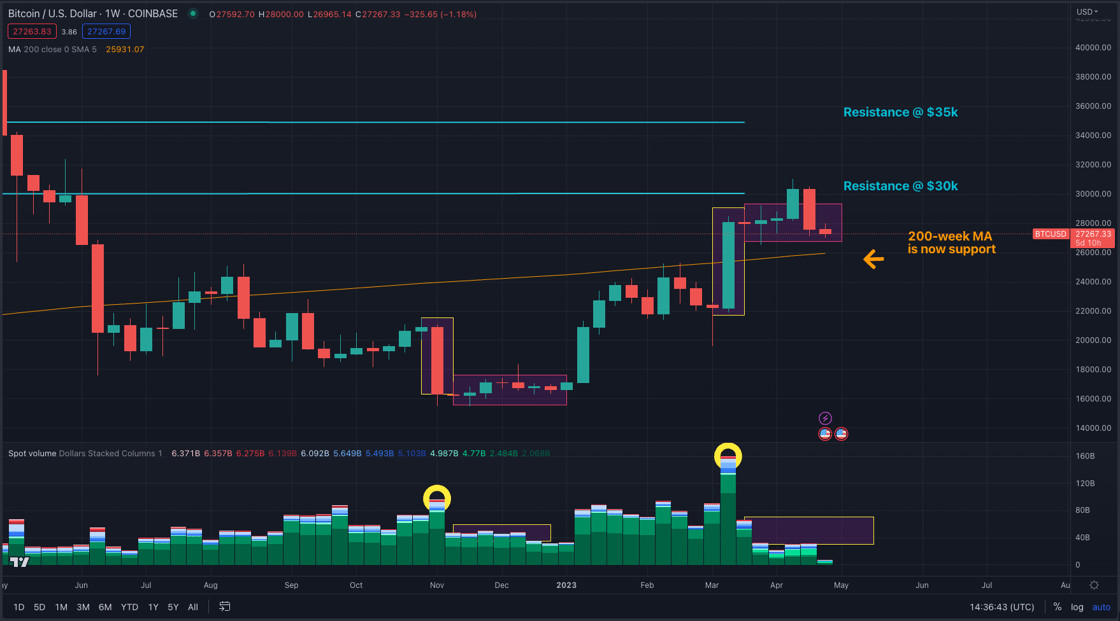
Last week bitcoin sold off by more than -9% to approximately $27,500 in what was a very active week of regulatory updates around the world.
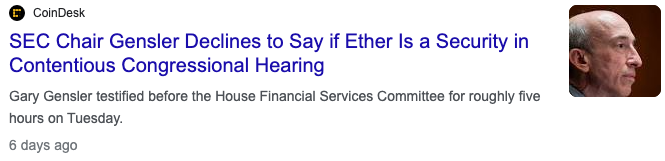
The main catalyst to the downside was a testimony by SEC Commissioner Gary Gensler to the House Financial Services Committee, where he was asked about SEC’s role in regulating the cryptocurrency industry. One key highlight of the speech - which we will cover in depth in our next section - was the fact that Mr. Gensler was asked point blank if Ethereum is a security in the eyes of the Securities and Exchange Commission, and he refused to give a “yes” or “no” answer.
The day of the speech, Ethereum dropped in price by -8%, and has dropped by another -6% since - for a cumulative -14% drop. In contrast, Bitcoin is down -10% since the speech. |
 |
This narrative could continue putting downward pressure on prices over the next few weeks, as investors continue to digest the SEC’s recent enforcement actions. The narrative will likely be offset by news of regulatory doors that are opening up internationally to welcome crypto businesses.
In terms of near-term catalysts, we have a couple of events that are setting up the market for more potential volatility.
The first one is the upcoming options expiration date on Friday, where 110,000 BTC worth of notional contracts are set to expire. Coincidentally, the “max pain” price for Friday’s expiration is $27,500. This is the price at which most contracts expire worthless, and options issuers have an incentive to keep prices near these levels until expiration. Markets could remain stable until Friday and become more volatile into the weekend.
The second volatility event will be the Fed’s interest rate decision scheduled for May 3rd.Given the recent rally we’ve seen in markets, and how core inflation has remained “sticky” in the U.S., we will likely see the Federal Reserve raise interest rates by another +0.25% to 5.25%. Mr. Powell could also use this opportunity to “talk down markets” - hinting that the Fed intends to keep rates high for longer than investors anticipate. He needs to do this to keep the “wealth effect” in check, and prevent people from continuing to bid asset prices higher.
In terms of key support and resistance levels, we are monitoring the 200-week moving average price as potential support - currently at $25,931. In terms of resistance, we continue to monitor the $30k level, which was tested and rejected last week. Beyond that, we are looking at $35k as the next key resistance level. |
Digital Asset Markets:
1. One Country’s “trash” is everyone else’s treasure
Last week highlighted just how challenging the current regulatory environment in the U.S. is for the digital asset industry. In a clip that appeared to be almost out of a comedy sketch, the SEC Commissioner Gary Gensler was asked if Ethereum was a security, which he refused to answer for about 3 minutes. |
 |
During the testimony, Mr. Gensler was also asked by some members of the Committee if he thought that the uncertainty around what was a security was “a good thing” for the industry - and he was pressed on the more than 50 enforcement actions he has brought to the crypto industry and beyond.
Digital asset markets sold off during and after the testimony, signalling that, while there is a clear understanding that bitcoin is a commodity in the eyes of U.S. regulators, the lack of regulatory clarity for the broader crypto industry impacts the ecosystem - including bitcoin.
Over the last 12 months, the U.S. has transformed from a friendly jurisdiction that welcomed crypto ETFs in 2021 and 2022, allowed Coinbase to go public, and dominated crypto banking infrastructure through now-defunct banks like Silvergate and Signature, to a full-on crusade against the industry and the banks that supported it.
The reaction from the industry - and from other states that see the opportunity, has not taken long.
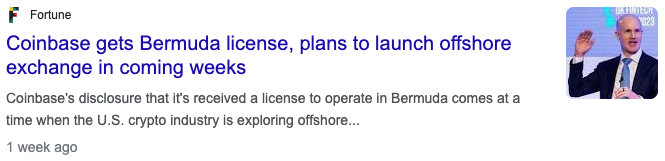
Companies are already setting up offshore entities Last week we learned 2 of the largest exchanges still operating in the U.S. announced the creation of their respective offshore entities. |
 |
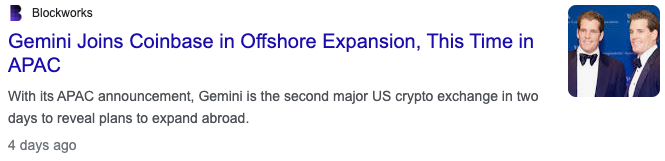
Within days, Gemini also announced that it had created its own offshore entity as well: |
 |
Granted, these licenses are not issued overnight. This had likely been in the works for months - but it’s not surprising that we are seeing offshore regulators “accelerate” the approvals of such applications.
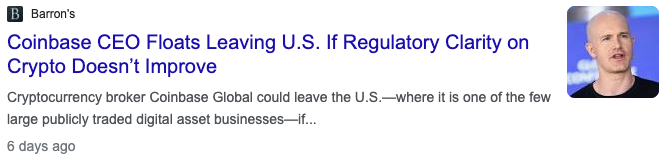
Coinbase went as far as to tease that they could look to leave the U.S. entirely if regulatory clarity doesn’t improve. |
 |
And while U.S. continues to make the life of crypto companies difficult, virtually all other regulators are competing to attract them. We’ve compiled a few examples below.
EUROPE: European Union passes MiCA regulation for digital assets |
 |
The following quote is taken straight from the plenary debate about this regulation: “MiCA will allow EU-authorised crypto-asset service providers to passport their services throughout the European Union. In return, these operators will be subject to stringent prudential and conduct rules, in addition to rules against insider trading and market manipulation”
Translation: get one cohesive license with clear guidelines to access a large market. Music for any company’s ears.
ASIA: Hong Kong is creating a “regulate to protect” framework for the crypto industry |
 |
Earlier in February this year, the Hong Kong Securities and Futures Commission published its proposed rules for virtual asset trading platforms and is seeking public commentary.
While the framework has not yet been finalized, it signals the intention to welcome the industry - which is a very different stance than what was expressed by mainland China regulators in years prior.
MIDDLE EAST: Dubai announced a crypto licensing regime aimed to attract firms seeking regulatory clarity |
 |
Under Dubai's new rules, all entities planning to offer one or more crypto-related services in the region have to obtain the necessary licenses. The regulatory framework is complemented by four “rulebooks” for service providers and seven “activity-based rulebooks” that list the requirements by the type of service offered.
Dubai is actively luring crypto companies to set up in the region, having had some success so far. Binance has been very active in the region this year, and other players have announced setting up, or are exploring, regional hubs in Dubai.
LATIN AMERICA: El Salvador starts processing Digital Asset Licenses |
 |
Two weeks ago the government of El Salvador granted the first ever Digital Asset License to crypto exchange BitFinex. The license is the first issued under a regulatory framework passed in January of this year. It will allow Bitfinex to issue “tokenized shares and yield-bearing assets”.
As you can see, regulatory actions have strategic consequences. The U.S. is making a strategic blunder by taking a “shoot first, ask questions later” approach to crypto regulation. The U.S. is in the privileged position to be able to “kick out” an industry that it does not want to figure out. They are literally kicking out thousands of jobs and billions of dollars in investment. More importantly, this is the industry where the best and the brightest want to work to change the world. Even if they are American, they will move if they have to do so to chase their dreams. I know I did when I had to. May American politicians not forget that the world is, indeed, a big place.
|
The Week Ahead
The week ahead will have several market catalysts: a large options expiration day on Friday, and PCE data on Wednesday. This week we also reach the 1-year mark until the next Bitcoin Halving. Expect this narrative to start picking up steam in the months to come. The Bitcoin Halving is a highly anticipated event that shocks the bitcoin mining reward supply in half every 4 years, and has historically led to a rally in prices.
Friday will deliver March data for Personal Consumption Expenditures inflation in the U.S.. It will be the last inflation reading before the Fed’s interest rate decision next week.
As covered above, we also have a big Bitcoin Options expiration date on Friday, and relevant earnings reports in the likes of Microsoft, Alphabet (Google), Visa, McDonalds, Amazon, Intel, MasterCard and more.
As always, here’s a summary of the events and data that could move markets in the week ahead: |
Comments
Post a Comment